The snack food category has one of the most demanding secondary packaging briefs in FMCG. A bag of crisps, a case of protein bars, or a pallet of granola pouches has to survive a supply chain from factory floor to retail shelf or consumer doorstep - without damage, without losing shelf presence, and increasingly without generating unnecessary packaging waste.
Corrugated secondary packaging is the workhorse of that supply chain. It is the transit outer that protects product in shipping, the shelf-ready display case that determines how product lands on the retail fixture, and the branded shipper box that DTC snack brands use to create an unboxing moment at the doorstep. For UK and US snack food brands looking to reduce packaging costs without reducing quality, India has become a serious sourcing option.
This guide covers what snack food brands actually need to specify when sourcing corrugated boxes from India, which certifications matter for retail buyers and UK EPR compliance, and what to expect on MOQ, lead times, and quality assurance. If you are still deciding whether to source packaging from India at all, our guide to importing corrugated boxes from India covers the broader vetting process first.
 Biscuits, pastries, protein bars, granola, crisps and dried snacks are all ambient food formats that use corrugated secondary packaging for wholesale distribution and e-commerce fulfilment.
Two Formats, Different Briefs: Shipping Outers vs Shelf-Ready Packaging
Shipping Outers and Transit Boxes
Most snack food brands start with a single need: a corrugated outer that holds a given number of retail units, survives palletisation and freight transit, and stacks safely in a warehouse or distribution centre.
The specification brief for a shipping outer is relatively straightforward:
Box style: Regular Slotted Container (RSC) is the standard. RSC boxes close top and bottom with flaps, are straightforward to pack by hand or machine, and are cost-effective to manufacture at scale.
Board grade: For snack food products sealed in primary packaging (heat-sealed film pouches, foil bags, wrappers), a B-flute single-wall at 150 to 200 GSM liner is adequate for most transit requirements. Products with higher stacking loads, or with moisture risk in transit, benefit from C-flute with higher burst strength.
Internal dimensions: Specify to the millimetre. Measure your primary pack dimensions and how units will be arranged inside the outer (2x4, 3x4, etc.). Factory-direct manufacturers can cut to any dimension at no additional tooling cost for RSC styles.
Print: RSC shipping outers are typically plain or one-colour flexo-printed with brand name, product name, lot code panel, and handling instructions. A second colour is achievable at modest cost.
For a detailed comparison of B-flute and C-flute performance differences in snack food secondary packaging, our guide to B-flute, C-flute, and E-flute corrugated boxes covers the trade-offs in strength, printability, and weight for each format.
Shelf-Ready Packaging (SRP)
Shelf-ready packaging (also called retail-ready packaging, or RRP) is a corrugated format designed to move from the stockroom to the retail shelf without repacking. UK grocery retailers including Tesco, Sainsbury's, ASDA, and Waitrose increasingly require SRP compliance for ambient snack categories as a condition of supply.
SRP boxes are engineered differently from standard shipping outers:
Perforated tear strip: A precisely scored perforation runs around three sides of the box, typically at a height that leaves a low tray with the product visible. The shelf-fill team tears the strip to convert the shipping case directly into a display tray.
Printed front panel: The front face of the box (the panel facing the shopper once opened) is print-finished with the brand logo, product name, and shelf talker information. This print face is often the consumer's first visual cue on the shelf.
Base and side panel strength: The remaining tray needs enough rigidity to hold product weight without bowing during the stock rotation period. Double-wall base construction or a reinforced base score is common for heavier snack formats.
Print registration: Because the front panel is the shelf display face, print registration on SRP boxes needs to be held to tighter tolerances than a standard shipping outer.
A well-specified SRP box reduces shelf-fill labour time, improves on-shelf compliance, and removes the need for a separate display unit. UK grocery buyers treat SRP capability as a baseline expectation from mid-tier brands and above.
 Shelf-ready packaging (SRP) uses a corrugated outer with a perforated tear strip that converts to a retail display tray. UK grocery retailers mandate this format across most ambient snack categories as a condition of supply.
Board Grade and Food Safety for Snack Packaging
Most snack food products (crisps, granola, protein bars, biscuits, dried fruit, nuts, energy bars, crackers) are sealed in primary packaging before they go into a corrugated outer. The corrugated box is secondary packaging: it does not contact food directly.
This means food safety requirements for corrugated secondary packaging are less demanding than for primary contact materials. There are, however, a few areas where snack food brands should pay attention.
FSC Certification
UK retailers with sustainability commitments, and an increasing number of US retailers, require FSC chain-of-custody certified packaging as a supplier compliance condition. FSC certification confirms the fibre in the corrugated board came from responsibly managed forests or recycled sources. Indian corrugated manufacturers who export to UK and European buyers typically hold FSC chain-of-custody certification. Request the certificate number and verify it at info.fsc.org before confirming an order.
Recycled Content
High-recycled-content board is standard in the Indian corrugated industry. Boards using 70 to 100% post-consumer waste fibre are available, biodegradable, fully recyclable through standard paper and cardboard collection streams, and acceptable for most retail buyer sustainability requirements. For UK brands managing Extended Producer Responsibility (EPR) reporting, your supplier should be able to provide a material data sheet specifying recycled content percentage by layer.
Ink and Coating Specification
Corrugated boxes for food brands should be printed with water-based inks rather than solvent-based inks. Water-based inks do not off-gas solvents in a closed secondary packaging environment and keep the board fully recyclable at end of life. Request a written ink specification from your supplier. Any wax or plastic coating (sometimes used to add moisture resistance) makes the board non-recyclable and should be avoided unless absolutely required for the application.
For the full picture on eco-certification options for corrugated packaging from India, including FSC, recycled content declarations, and UK EPR documentation requirements, see our guide to eco-friendly packaging from India.
Custom Printing: Getting the Shelf Presence Right
The corrugated box is increasingly a brand touchpoint, not just a container. For snack food brands, there are two moments where print quality matters most: the SRP front panel (retailer-facing) and the e-commerce shipper (consumer-facing).
Flexographic Printing
Flexographic printing is the standard for corrugated packaging. It prints directly onto the corrugated board surface using flexible rubber plates. Constraints to be aware of:
- Fine lines and small text below 6pt are difficult to reproduce cleanly on corrugated surfaces
- Photographic gradients reproduce poorly - use solid colour fills and bold graphics for best results
- Colour matching to brand standards (Pantone references) is achievable with experienced operators but requires a press proof run before full production
High-Definition Flexo and Litho-Laminate
For premium snack brands where the outer carton needs to match the quality of retail shelf primary packaging, high-definition flexo printing or litho-laminate construction is available from specialist Indian manufacturers:
- High-definition flexo achieves finer dot reproduction and closer Pantone matching than standard flexo
- Litho-laminate involves a pre-printed lithographic sheet laminated onto corrugated board, giving near-offset print quality on a corrugated base
Both options add cost and lead time but are appropriate for premium retail ranges where the box is a consumer-facing brand element.
E-Commerce Branded Shippers
For DTC snack brands, the shipper box is the unboxing experience. Custom-printed single-wall corrugated boxes with full-colour or spot-colour exterior print, combined with a kraft or white liner interior, are the most common format. Box styles include RSC (most economical), mailer-style with tuck-in lid (better opening experience), and die-cut display boxes.
For guidance on custom print specifications including artwork requirements and the press proofing process, our custom-printed corrugated boxes guide covers the process from artwork to delivery.
MOQ, Lead Times, and Getting Started
Minimum Order Quantities
At Whizzpack, the minimum order quantity for corrugated boxes is 5,000 units per SKU (per size, flute type, and print specification). This MOQ applies to both plain and custom-printed boxes. Multi-SKU orders can be combined to reach the minimum: a brand with three shipping outer sizes can order 1,500 to 2,000 units of each as part of a combined order.
Lead Times from India
- Production (plain or one-colour): 20 to 25 working days after order confirmation and approved artwork
- Production (custom-printed, 2 to 4 colours): 25 to 35 working days
- Sea freight to UK ports (Felixstowe, Southampton): 18 to 25 days
- Sea freight to US East Coast (New York, Savannah): 22 to 30 days
Total order-to-delivery for a first order: 8 to 12 weeks. For established reorder relationships on confirmed specifications, 6 to 8 weeks is typical.
Sampling
Any new specification should go through a sampling step before full production. A corrugated box sample from an Indian manufacturer lets you verify dimensions, board quality, print quality, and tear-strip performance (for SRP formats) before committing to production quantities. Our guide to requesting a corrugated box sample from India explains what to provide and what to expect from the process.
UK Import Duty
Corrugated boxes imported from India to the UK attract a specific import duty rate. Our UK corrugated box import guide covers HTS codes, UK tariff rates, and landed cost calculations before placing an order.
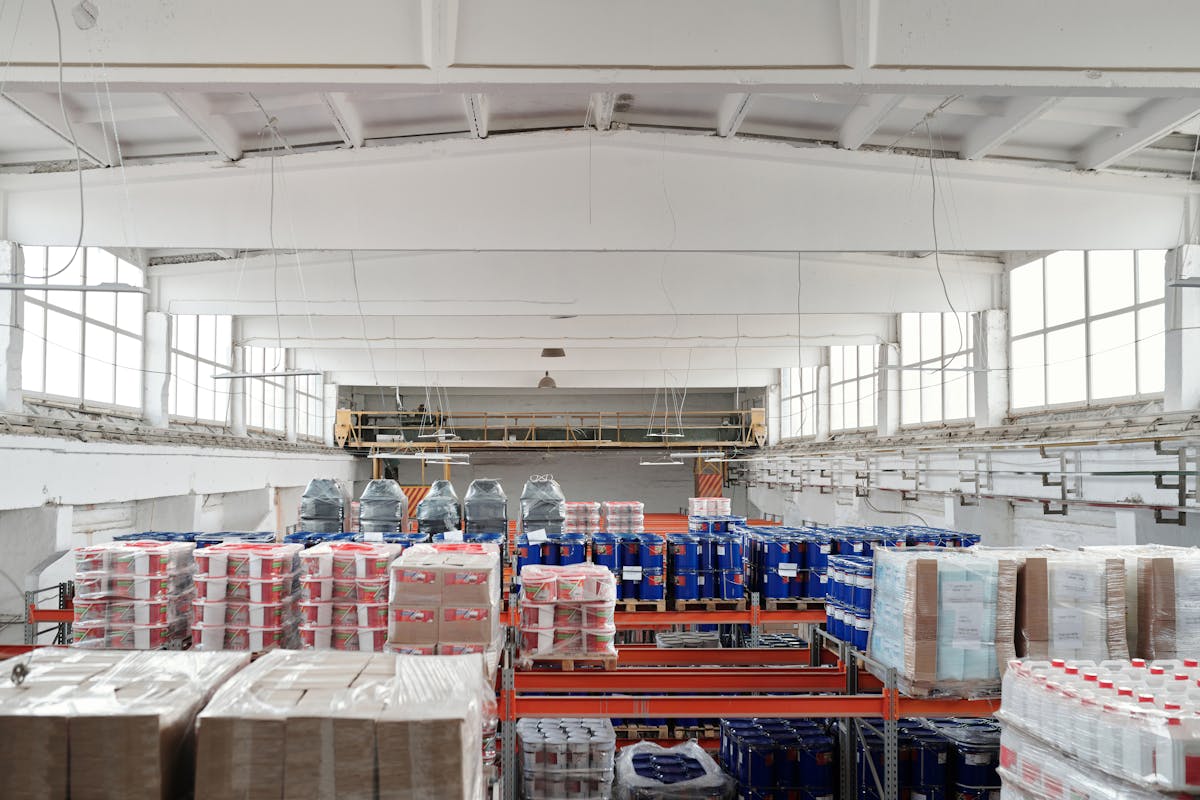 FMCG distribution warehouses stack palletised corrugated secondary packaging through multiple levels of racking. Board grade, compression strength, and stacking performance are key specifications for snack food brands planning for ambient warehouse storage.
Frequently Asked Questions
What corrugated box specification should a snack food brand use for shelf-ready packaging?
For shelf-ready packaging (SRP), snack food brands typically use B-flute or C-flute single-wall construction with a perforated tear strip scored at shelf tray height and a printed front panel for on-shelf visibility. B-flute gives a flatter board surface for better print quality; C-flute gives higher stacking strength for heavier snack formats. The base of the remaining tray should be reinforced if product weight exceeds 2 to 3 kg per display tray. Print specification should prioritise solid colour fills and bold graphics rather than photographic gradients, which do not reproduce cleanly on standard flexo corrugated print.
Do corrugated boxes from India meet UK retailer FSC requirements?
Yes. Established Indian corrugated exporters hold FSC chain-of-custody certification covering their board supply. FSC chain-of-custody certification confirms the fibre came from responsibly managed forests or recycled sources and is the standard certification required by UK grocery retailers including Tesco, Sainsbury's, Waitrose, and ASDA for packaging sustainability requirements. Request the certificate number from your supplier and verify it at info.fsc.org before confirming an order.
Can Indian manufacturers produce corrugated boxes suitable for food brand retailer audits?
For corrugated secondary packaging where the box does not contact food directly, the key compliance documents are an FSC chain-of-custody certificate, a recycled content declaration, and an ink specification confirming water-based inks. These cover the requirements for most UK and US food brand retailer audits. For any application where corrugated board may contact food directly, ask specifically for a food-contact compliance declaration and confirm the board grade meets the relevant standard.
What is the minimum order quantity for corrugated snack food packaging from India?
The minimum order quantity at Whizzpack is 5,000 units per specification (per size, board grade, and print). Multi-SKU orders for brands with several box sizes can combine quantities across SKUs to reach the minimum. For a first order, we recommend treating the initial run as a specification-confirmation order: sample first to confirm dimensions, board quality, and SRP tear-strip performance, then place the first production run at full quantities once the specification is locked.
How does sourcing corrugated boxes from India compare to a local UK supplier for a snack food brand?
Indian manufacturers offer significantly lower unit cost for medium-to-large production runs, full custom specification capability (any size, board grade, custom SRP engineering, full-colour print), and strong FSC and recycled content credentials. The trade-off is lead time: an Indian supplier requires 8 to 12 weeks total for a first order versus a few days from a local UK supplier. The practical approach for snack food brands is to use Indian suppliers for planned seasonal or new product launch runs, placed 14 to 16 weeks in advance, and maintain a small buffer stock from a local supplier for reactive top-up needs.
Whizzpack manufactures corrugated boxes at our factory in Rajkot, Gujarat, supplying snack food brands, FMCG importers, and retail-ready packaging buyers across the UK and US. We supply both plain transit outers and custom-printed shelf-ready packaging, with FSC certification, recycled content documentation, and water-based ink specifications available as standard for export orders.
Visit our corrugated boxes page to discuss your snack food packaging specification.